
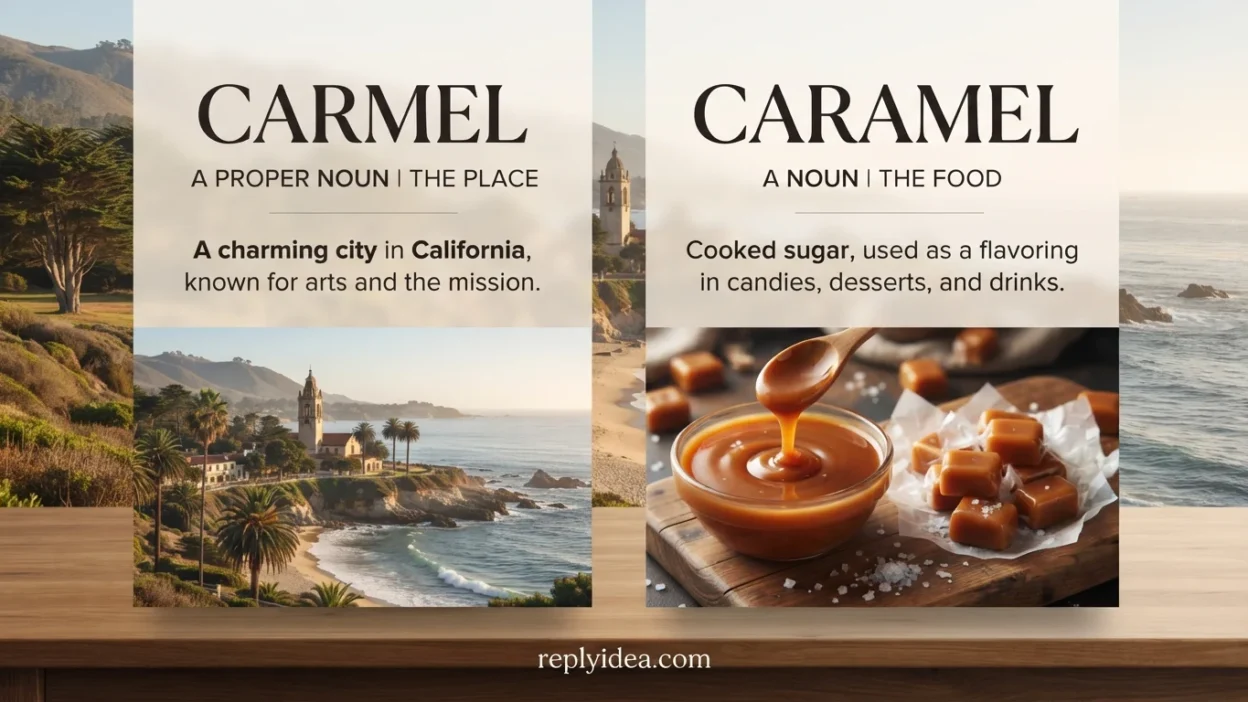
Carmel or caramel is a common spelling and pronunciation question in English. The two words look very similar, so it is easy to mix them up. However, they usually have completely different meanings.
Caramel is the word for a sweet food made by heating sugar. You may see caramel in desserts, candy, coffee, cakes, ice cream, and sauces.
Carmel, on the other hand, is usually a proper name. It can be the name of a person, place, or other named thing. For example, Carmel is the name of a city in California, and it also appears in several personal and geographic names.
The confusion often comes from pronunciation. Some people pronounce caramel with two syllables, while others use three. Because of this, caramel can sometimes sound a little like Carmel.
Let us look at the difference in simple English.
Quick Answer
- Caramel is a sweet substance made by heating sugar.
- Carmel is usually a proper name or place name.
- Use caramel when talking about food, candy, desserts, sauces, or flavor.
- Use Carmel when referring to a specific person, place, or name.
- Caramel may be pronounced in different ways depending on the speaker or region.
- The spelling Carmel is not normally the correct spelling for the sweet food.
- The spelling caramel is correct when you mean the sweet ingredient or flavor.
Easy trick to remember
Think:
Caramel = candy and sweet food
Carmel = a name or place
A Simple Background of the Two Words
The word caramel has a long history connected with sugar and cooking. It refers to sugar that changes when it is heated. As sugar gets hot, it melts and develops a brown color and a rich, sweet taste.
Today, caramel is used in many foods and drinks. It can be soft, hard, liquid, chewy, or used as a flavor.
The word Carmel has a different history. It is used as a name in several places and personal names. One well-known example is Carmel-by-the-Sea, a city in California. The name also appears in religious and geographic contexts.
Because the two words sound similar in some forms of English, people sometimes write one when they mean the other.
What Does Caramel Mean?
Caramel is a sweet food ingredient or flavor made when sugar is heated.
When sugar is heated, it changes in color, smell, texture, and taste. It can become golden brown or dark brown and develop a rich flavor.
Caramel can be found in:
- Ice cream
- Cakes
- Cookies
- Candy
- Coffee
- Pudding
- Chocolate
- Caramel apples
- Dessert sauces
- Flavored drinks
Examples
- “I added caramel sauce to my ice cream.”
- “She ordered a caramel latte.”
- “These cookies have a soft caramel filling.”
- “I love the sweet taste of caramel.”
In each sentence, caramel refers to food or flavor.
What Does Carmel Mean?
Carmel is generally used as a proper name rather than the name of a sweet food.
A proper name is the special name of a person, place, organization, or other specific thing. Because it is a proper name, Carmel is normally written with a capital C.
For example:
- Carmel can be part of a person’s name.
- Carmel can refer to a place.
- Carmel can appear in geographic names.
- Carmel can appear in religious names or references.
Example
“Carmel is a beautiful coastal city.”
Here, Carmel is the name of a place.
If you are talking about the sweet brown food, however, Carmel is usually not the word you want.
Carmel vs. Caramel: The Main Difference
The biggest difference is meaning.
Caramel is a common noun related to food. Carmel is generally a proper name.
Compare these two sentences:
“I bought caramel ice cream.”
Here, caramel describes the flavor of the ice cream.
“We visited Carmel during our trip.”
Here, Carmel is a place name.
The spelling is important because changing one letter can change the meaning completely.
Another source of confusion is pronunciation. Depending on the speaker, caramel may sound like it has two or three syllables. In some accents, it may sound close to Carmel.
That does not mean the words have the same meaning.
Carmel or Caramel: Comparison Table
| Feature | Carmel | Caramel |
|---|---|---|
| Main meaning | A name or place | A sweet food or flavor |
| Type of word | Usually a proper noun | Common noun |
| Capital letter | Usually capitalized | Usually lowercase |
| Used for food? | Usually no | Yes |
| Used for places? | Yes | No |
| Used for flavor? | No | Yes |
| Example | “We visited Carmel.” | “I love caramel.” |
| Related to sugar? | No | Yes |
Which One Should You Use and When?
Choosing between Carmel and caramel is easy once you know what you mean.
Use “caramel” for food
Choose caramel when you are talking about:
- A sweet sauce
- A candy
- A dessert flavor
- Heated sugar
- A drink flavor
- A topping
- A filling
Examples
- “Can I have caramel on my pancakes?”
- “This coffee has a caramel flavor.”
- “She made caramel sauce.”
- “He bought a caramel candy.”
Use “Carmel” for a name or place
Choose Carmel when it is part of a specific name.
Examples
- “They traveled to Carmel.”
- “She lives near Carmel.”
- “The hotel is located in Carmel.”
- “Carmel is mentioned in the story.”
A simple question can help:
Am I talking about something sweet?
If yes, you probably need caramel.
Am I talking about a specific name or place?
If yes, Carmel may be correct.
Common Mistakes People Make
1. Writing “Carmel” when they mean the sweet food
A common mistake is writing:
“I love Carmel ice cream.”
If the intended meaning is the flavor, the better spelling is:
“I love caramel ice cream.”
2. Assuming pronunciation tells you the spelling
English pronunciation can be tricky. Some speakers pronounce caramel with two syllables, while others pronounce it with three.
Because of these differences, you should not choose the spelling only by sound.
Instead, think about the meaning.
3. Forgetting the capital letter in “Carmel”
When Carmel is being used as a proper name, it normally begins with a capital C.
For example:
“We visited Carmel.”
Not:
“We visited carmel.”
However, caramel is normally lowercase because it is a regular food word.
4. Treating the two words as different spellings of the same thing
They are not simply two spellings of one word.
Caramel and Carmel can refer to different things. Their similar appearance and pronunciation are what cause much of the confusion.
Everyday Real-Life Examples
Understanding these words becomes easier when you see them in everyday situations.
In Emails
Imagine someone writing to a restaurant:
“Could you please add caramel to my dessert?”
Here, caramel is correct because the person is asking for a sweet topping.
Another email might say:
“I will be staying in Carmel next weekend.”
Here, Carmel is correct because it refers to a place.
In News
A news story might say:
“The family visited Carmel during their holiday.”
The word Carmel refers to a location.
Another story could say:
“The bakery introduced a new caramel dessert.”
The word caramel refers to food.
On Social Media
People may write:
“This caramel latte is amazing!”
The spelling caramel is correct because the post is about a drink flavor.
Someone else might post:
“Beautiful sunset in Carmel!”
Here, Carmel is a place name.
In Daily Conversation
You might hear:
“Do you want caramel on your ice cream?”
The answer is caramel.
You might also hear:
“Where are you traveling?”
If the answer is:
“Carmel.”
The word is a proper name.
A Short Learning Section for Students and Beginners
If English is not your first language, these two words can be confusing because English spelling does not always match pronunciation.
The easiest way to learn them is to connect each word with an idea.
Remember this pair:
Caramel → sweet → sugar → dessert
Carmel → name → place → person
You can also practice by making your own sentences.
Practice
Fill in the blank with Carmel or caramel:
- I ordered a ______ coffee.
- We visited ______ during our vacation.
- She made a ______ sauce.
- ______ is the name of the town.
- The cake has a delicious ______ filling.
Answers
- caramel
- Carmel
- caramel
- Carmel
- caramel
This simple exercise helps you focus on meaning rather than pronunciation.
Why Is Caramel Pronounced in Different Ways?
One reason people confuse these words is that caramel does not have exactly the same pronunciation everywhere.
Some English speakers pronounce it with two syllables, while others pronounce it with three syllables.
For example, you may hear pronunciations that sound roughly like:
- “CAR-mel”
- “CAR-uh-mel”
The exact sound can vary by region and accent.
This is normal in English. Different speakers can pronounce the same word differently without either pronunciation being a spelling of Carmel.
The spelling remains caramel when the meaning is the sweet food.
FAQs:
1. Is Carmel the same as caramel?
No. They usually have different meanings. Caramel is a sweet food or flavor, while Carmel is generally a name or place.
2. How do you spell the sweet food?
The correct spelling is caramel.
3. Should Carmel have a capital letter?
Yes, when Carmel is used as a proper name, it should normally have a capital C.
4. Why do caramel and Carmel sound similar?
The pronunciation of caramel varies among English speakers. Some pronunciations sound quite close to Carmel.
5. Can I write “Carmel” for caramel sauce?
Usually no. If you mean the sweet sauce made from sugar, write caramel sauce.
6. Is caramel only used for candy?
No. Caramel can describe candy, sauces, desserts, drinks, fillings, toppings, and flavors.
7. Is Carmel a place?
Yes. Carmel is used in the names of several places. The exact place depends on the context.
8. What is the easiest way to remember the difference?
Remember:
Caramel = sweet food.
Carmel = name or place.
Conclusion
The difference between Carmel and caramel is simple once you focus on meaning.
Caramel is the word you need when talking about a sweet substance, dessert, candy, sauce, or flavor made from or associated with heated sugar.
Carmel is generally used as a proper name, especially for a person or place.
The words can sound similar because caramel has different pronunciations in English. This is why even fluent speakers sometimes become confused about them.
For students and beginners, the easiest rule is:
If it is sweet, use “caramel.” If it is a name or place, use “Carmel.”
With this simple distinction, you can choose the correct word confidently in writing and everyday conversation.