
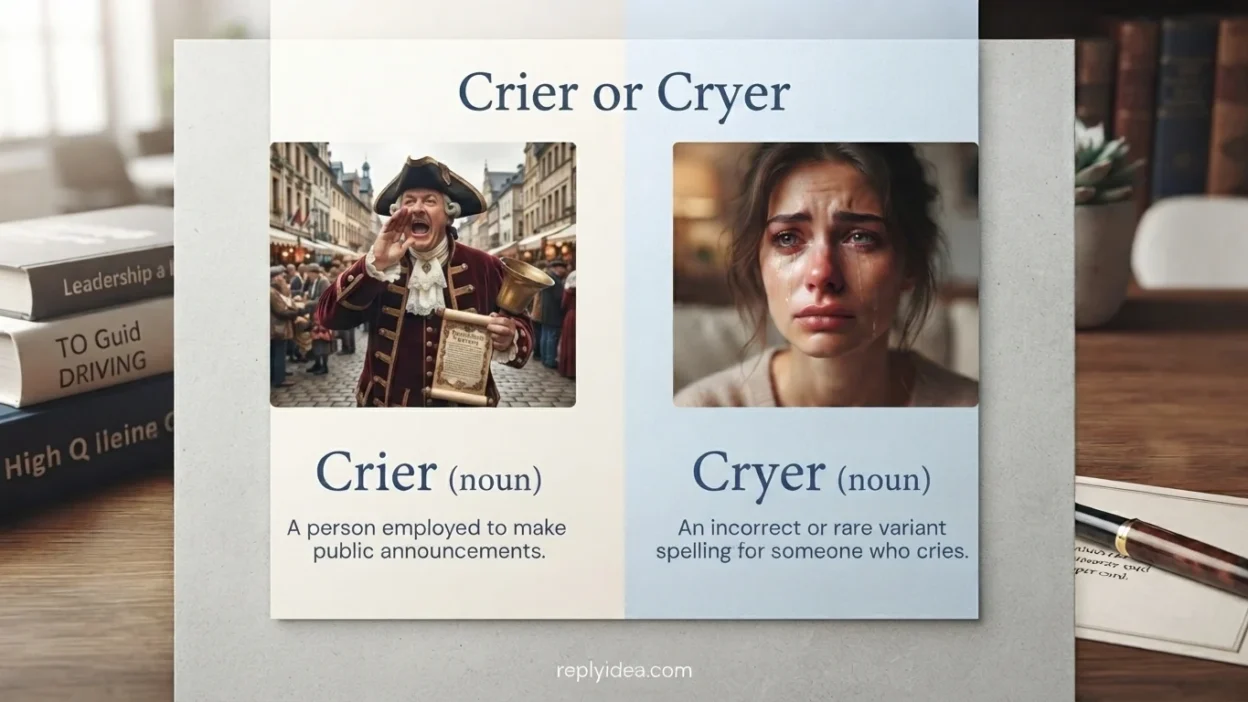
“Crier” and “cryer” look almost the same, so it is easy to wonder which spelling is correct. Both words are connected to the verb cry, but they are not used in exactly the same way.
For most everyday writing, crier is the word you should choose. It can describe a person who cries often or someone whose job involves making a public announcement. Cryer is a much less common spelling and may appear in some names, older texts, or unusual uses.
If you have ever stopped while writing and thought, “Should I write crier or cryer?” this guide will make the difference simple.
Quick Answer: Crier or Cryer?
- Crier is the standard and much more common spelling.
- A crier can mean a person who cries often.
- A crier can also mean a person who makes public announcements, especially a town crier.
- Cryer is uncommon in modern English.
- In normal school, work, and everyday writing, crier is usually the correct choice.
- The word comes from cry, with -er added to describe a person who does something.
- If you mean someone who cries easily or frequently, use crier.
Easy rule
Cry + er = crier
So, when you need the normal English word, remember:
Crier = the usual spelling
Where Does “Crier” Come From?
The word crier comes from the verb cry. The ending -er is often added to a verb to describe a person who performs an action.
For example:
- teach → teacher
- work → worker
- sing → singer
- run → runner
- cry → crier
A crier, therefore, can simply mean someone who cries.
The word also has a longer history. In the past, people called public announcers criers because they would cry out or speak loudly to share important information. The best-known example is the town crier, whose job was to announce news in public places.
The spelling cryer can be found occasionally, but it is not the normal spelling used in modern standard English.
What Does “Crier” Mean?
Crier is a noun. It has two main meanings.
1. A person who cries
A crier can be someone who cries frequently or easily.
For example:
- “The baby is a loud crier.”
- “He was always a crier when he was young.”
- “She is not a crier, even when she is upset.”
In these sentences, crier describes a person who cries.
2. A public announcer
A crier can also be someone who announces news or information publicly.
The familiar phrase is town crier.
Historically, a town crier would walk through a town and loudly announce important news, such as official messages, public events, or changes in local rules.
For example:
“The town crier announced the news to everyone in the square.”
This meaning is less common in everyday modern life, but the phrase town crier is still well known.
What Does “Cryer” Mean?
Cryer is an uncommon spelling of the word related to someone who cries.
You may see cryer in some older writing, names, family names, or less common sources. However, it is not normally the preferred spelling when you are writing standard modern English.
For students and ESL learners, there is no need to make the choice difficult:
Use “crier” in normal English writing.
If you see cryer, understand that it may be an alternative or uncommon form, but do not normally choose it over crier.
Crier vs. Cryer: The Main Difference
The biggest difference is standard usage and spelling.
| Word | Meaning | Common in modern English? | Example |
|---|---|---|---|
| Crier | A person who cries | Yes | “The baby is a frequent crier.” |
| Crier | A public announcer | Yes, especially in “town crier” | “The town crier shared the news.” |
| Cryer | An uncommon form related to someone who cries | No, not usually preferred | “Cryer” may appear in older or special uses. |
The important point is that crier is the normal spelling you should remember.
Which One Should You Use?
If you are writing an essay, email, school assignment, article, message, or social media post, choose crier when you need the noun for someone who cries.
Use “crier” when:
- You are talking about someone who cries often.
- You are describing a baby who cries frequently.
- You are talking about a person who cries easily.
- You are using the expression town crier.
- You want the standard modern spelling.
Be careful with “cryer”
You generally should not replace crier with cryer in ordinary modern writing.
For example:
Correct and natural:
“She was a frequent crier as a child.”
Unusual:
“She was a frequent cryer as a child.”
The first sentence is the better choice for standard English.
Why Do People Confuse Crier and Cryer?
The confusion mostly comes from the spelling of the word cry.
When people add -er, they may think the original spelling should remain unchanged:
cry + er = cryer
That looks logical at first.
However, English spelling does not always work by simply attaching an ending to a word. In this case, the standard noun is spelled crier.
Compare it with:
cry → cries → cried → crying → crier
The y changes to i in the noun.
This is similar to other English spelling patterns where letters change when an ending is added.
Common Mistakes People Make
Mistake 1: Using “cryer” everywhere
Because cryer looks natural, some people use it whenever they mean a person who cries.
Better: Use crier in standard modern English.
Mistake 2: Thinking “crier” only means someone who cries
The word has another meaning. A crier can also be a public announcer.
That is why you may hear the expression town crier.
Mistake 3: Confusing “crier” with “crying”
These words have different jobs.
- Crier = a person
- Crying = the action or process
Example:
“The baby is crying.”
Here, crying describes what the baby is doing.
“The baby is a frequent crier.”
Here, crier describes the baby as a person who cries frequently.
Mistake 4: Using “crier” when another word sounds more natural
Sometimes English speakers simply say someone who cries a lot instead of using the noun crier.
For example:
“He cries easily.”
This may sound more natural than:
“He is a crier.”
Both can make sense, but the first is often simpler in everyday conversation.
Everyday Examples of “Crier”
Here are some natural examples from different situations.
In daily conversation
“My little brother was a big crier when he was a baby.”
This means he cried frequently.
In a family conversation
“She is a crier when she watches sad movies.”
This means she often cries during emotional movies.
In school writing
“The story describes the main character as a quiet crier.”
Here, crier is used as a noun to describe the character.
In news or historical writing
“The town crier announced the king’s message.”
Here, crier means a person who publicly announces information.
In social media
Someone might write:
“I’m such a crier during emotional movies!”
This is an informal way of saying that they cry easily when watching emotional films.
In an email
A teacher or parent might write:
“The child was a frequent crier during his first week at school.”
Here, crier is used to describe a child who cried often.
A Simple Trick to Remember the Correct Spelling
If you often forget whether to use crier or cryer, connect the word with other nouns ending in -er.
Think:
- try → trier
- fry → frier
- cry → crier
The important spelling is:
C-R-I-E-R
Not:
C-R-Y-E-R
You can also remember the phrase:
A person who cries is a crier.
This short sentence can help you remember the spelling.
Crier or Cryer: What Should Students Write?
For students, the answer is very simple: write “crier.”
If you are completing a grammar exercise, writing an essay, answering an exam question, or preparing a formal assignment, crier is the safe and standard choice.
For example:
Use:
“The baby was a frequent crier.”
Avoid choosing:
“ The baby was a frequent cryer.”
The second spelling may appear in some sources, but it is not the normal choice for standard modern English.
FAQs:
1. Is “crier” the correct spelling?
Yes. Crier is the standard and common spelling in modern English.
2. Is “cryer” a real word?
You may find cryer in some sources, including older or special uses, but it is uncommon. Crier is the normal spelling to use in modern English.
3. What is a crier?
A crier can mean a person who cries frequently. It can also mean a person who publicly announces information, as in town crier.
4. Is “town crier” correct?
Yes. Town crier is the standard expression for a person who traditionally made public announcements by calling them out loudly.
5. Should I use “crier” in an essay?
Yes. If you mean a person who cries, crier is the standard choice for an essay or other formal writing.
6. Why is it “crier” instead of “cryer”?
The standard spelling changes the y to i before the ending, giving crier.
7. Can I use “crier” for a baby?
Yes. A baby who cries frequently can be described as a crier, although “a baby who cries a lot” may sound more natural in casual speech.
8. What is the easiest way to remember it?
Remember:
cry → crier
Think of crier as the standard noun for a person who cries.
Conclusion
The difference between crier and cryer is mainly a matter of standard spelling and usage. Crier is the normal and widely accepted spelling in modern English. It can describe someone who cries frequently, and it can also refer to a public announcer, especially in the phrase town crier.
Although you may occasionally see cryer, it is much less common and is not normally the spelling students and general writers should choose.
So, when you are unsure, keep it simple:
Crier = the standard choice.
If you are writing a school assignment, an email, a social media post, or an everyday sentence, crier is the word to remember.