
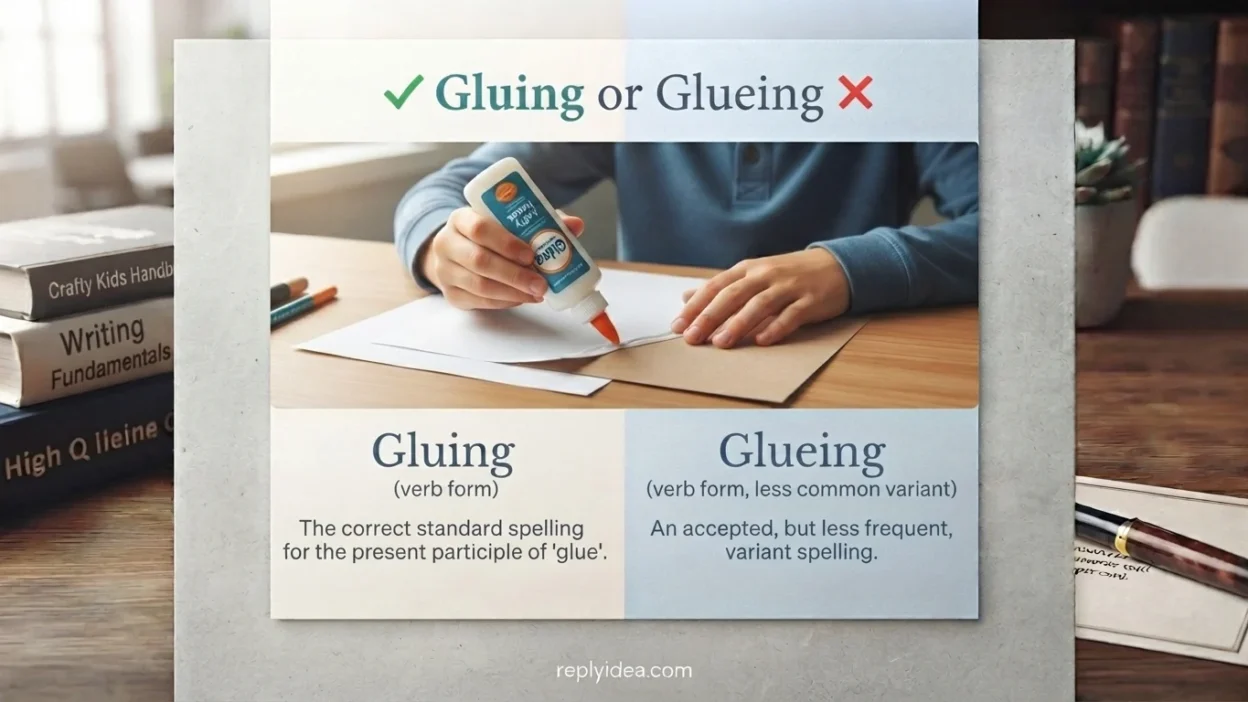
When people write the present participle of glue, they often wonder whether it should be spelled gluing or glueing. Both forms may look reasonable because the base word is glue, and adding -ing usually means simply putting the ending onto the original word.
The confusion comes from the final e in glue. In many English words, a final e disappears before -ing, such as make → making and write → writing. But glue already ends with the letters ue, so the spelling rule can feel less obvious.
The good news is that the answer is simple: gluing is the standard spelling in modern English. Glueing can be found in some writing, but it is much less common and is generally not the preferred form.
Let’s look at the difference carefully so you can use the correct spelling with confidence.
Quick Answer: Gluing or Glueing?
- Gluing is the standard and most widely accepted spelling.
- Glueing is a less common spelling that you may still see.
- Gluing means attaching something with glue.
- The base verb is glue.
- The past tense is glued.
- The present participle is normally gluing.
- For school, work, formal writing, and everyday English, choose gluing.
Example:
She is gluing the pieces of paper together.
A Simple Look at the Word “Glue”
The word glue is a verb and a noun.
As a noun, glue is a sticky substance used to attach things.
- The glue is on the table.
- This glue is very strong.
As a verb, glue means to attach something using glue.
- Please glue the paper to the card.
- I need to glue these two pieces together.
When we add -ing to glue, we get gluing:
glue → gluing
The spelling may seem unusual at first, but it is the normal form used in modern English.
Why Is It “Gluing” Instead of “Glueing”?
One reason this word causes confusion is that English spelling does not always follow one simple rule.
Usually, when a verb ends in a silent e, the e is dropped before -ing:
- make → making
- take → taking
- write → writing
- hope → hoping
The same basic idea gives us:
glue → gluing
However, glue does not look exactly like words such as make or write. Its ending contains ue, which makes glueing look natural to many readers.
Even so, gluing is the normal modern spelling.
Gluing vs. Glueing: The Main Difference
The main difference is spelling, not meaning.
Both gluing and glueing are connected to the verb glue. If someone writes glueing, the intended meaning is usually clear.
However, gluing is the spelling you should normally use.
Gluing
Gluing is the standard form.
It can describe an action happening now or an activity in progress.
Examples:
- Tom is gluing the box.
- She spent the afternoon gluing pictures into her notebook.
- We are gluing the broken pieces together.
Glueing
Glueing is an alternative spelling that appears occasionally.
You may encounter it in older texts, different dictionaries, or writing produced by people who follow a different spelling habit. However, it is much less common than gluing.
If you are unsure which form to choose, use gluing.
Comparison Table
| Feature | Gluing | Glueing |
|---|---|---|
| Base word | Glue | Glue |
| Meaning | Attaching with glue | Attaching with glue |
| Spelling | Standard | Less common |
| Common in modern English | Yes | Much less common |
| Suitable for school writing | Yes | Better avoided |
| Suitable for formal writing | Yes | Usually avoided |
| Example | She is gluing the card. | She is glueing the card. |
The important point is that the two forms do not normally represent two different actions. The difference is mainly about which spelling is preferred.
Which One Should You Use?
In almost every normal situation, choose gluing.
Use “gluing” in schoolwork
If you are writing an assignment, answering a question, or completing an English exercise, gluing is the safest choice.
Example:
The students are gluing colored paper onto the poster.
Use “gluing” in professional writing
For instructions, reports, emails, or workplace documents, gluing is the clearer standard form.
Example:
After gluing the parts together, allow them to dry.
Use “gluing” in everyday communication
You can use it in texts, social media posts, messages, and conversations.
Example:
I’m gluing the last piece onto my project.
What about “glueing”?
You may see glueing, but there is usually no reason to choose it when gluing is available.
For learners, remembering one simple rule is enough:
Common Mistakes People Make
1. Writing “glueing” because it looks natural
The spelling glueing may seem logical because you can see the whole word glue followed by ing.
However, standard modern usage generally prefers gluing.
Better:
I am gluing the pieces together.
2. Writing “gluying”
Some people may try to change the spelling to gluying.
This is incorrect.
Correct: gluing
Incorrect: gluying
3. Confusing “gluing” with “glued”
These words describe different forms of the verb.
- gluing = the action is happening or being described as an activity
- glued = the action has already happened
Examples:
- She is gluing the picture.
- She glued the picture yesterday.
4. Using “glue” when “gluing” is needed
Remember that glue is the base verb.
For example:
- I will glue the pieces together.
- I am gluing the pieces together.
- I glued the pieces together.
Each form has a different use.
Everyday Real-Life Examples
Seeing the word in normal situations can make the spelling easier to remember.
In an email
I am gluing the labels onto the boxes before sending them.
Here, gluing describes something currently being done.
In a school project
We spent two hours gluing pictures onto our science project.
The word describes an activity that happened over a period of time.
In instructions
Start by gluing the two pieces together.
Here, gluing is used as part of an instruction.
On social media
Finally finished gluing all the pieces onto my art project!
This is a natural informal use of the word.
In a conversation
“What are you doing?”
“I’m gluing this broken toy back together.”
In a news or community report
Volunteers were gluing posters onto cardboard boards for the school event.
Again, gluing is the normal spelling.
Other Forms of the Verb “Glue”
Learning the complete set of common forms can help you avoid mistakes.
| Form | Example |
|---|---|
| Glue | I will glue the pieces together. |
| Glues | She glues the paper carefully. |
| Glued | He glued the broken part yesterday. |
| Gluing | They are gluing the pieces together. |
Notice that the spelling changes slightly when -ing is added:
glue → gluing
But the past form is simple:
glue → glued
A Simple Learning Trick
If you often forget whether to write gluing or glueing, use this short memory trick:
Glue + ing = gluing
Think of the final e as being removed before -ing.
You can also remember a few similar patterns:
- use → using
- make → making
- write → writing
- glue → gluing
The exact spelling patterns are not identical in every English verb, but this comparison can help you remember the standard form.
For beginners, there is no need to memorize complicated spelling rules. Simply remember:
Gluing = correct standard choice.
FAQs:
1. Is “gluing” correct?
Yes. Gluing is the standard and most common spelling of the present participle of glue.
2. Is “glueing” wrong?
Glueing is not usually treated as a completely meaningless spelling, and it can be found in English writing. However, it is much less common than gluing and is generally not the preferred modern form.
3. What does gluing mean?
Gluing means attaching something with glue.
Example: She is gluing the pieces of the model together.
4. Why does “glue” become “gluing”?
The standard spelling drops the final e before adding -ing:
glue → gluing
5. Should I use “gluing” in school assignments?
Yes. Gluing is the safer and more standard choice for school assignments and other formal writing.
6. What is the past tense of glue?
The past tense is glued.
Example: I glued the paper to the notebook.
7. Is “gluing” used in American and British English?
Yes. Gluing is widely used in both American and British English. It is the spelling learners should normally use.
8. What is the easiest way to remember the spelling?
Remember this:
Glue → Gluing
Do not add another e before -ing.
Final Conclusion
The difference between gluing and glueing is mainly a matter of spelling. Both forms can be encountered, but gluing is the standard and much more common modern spelling.
If you are writing a school assignment, email, report, social media post, or everyday message, gluing is the best choice.
Remember the simple pattern:
Glue → Gluing → Glued
Once you learn this form, you can use gluing confidently whenever you want to describe the action of attaching something with glue.